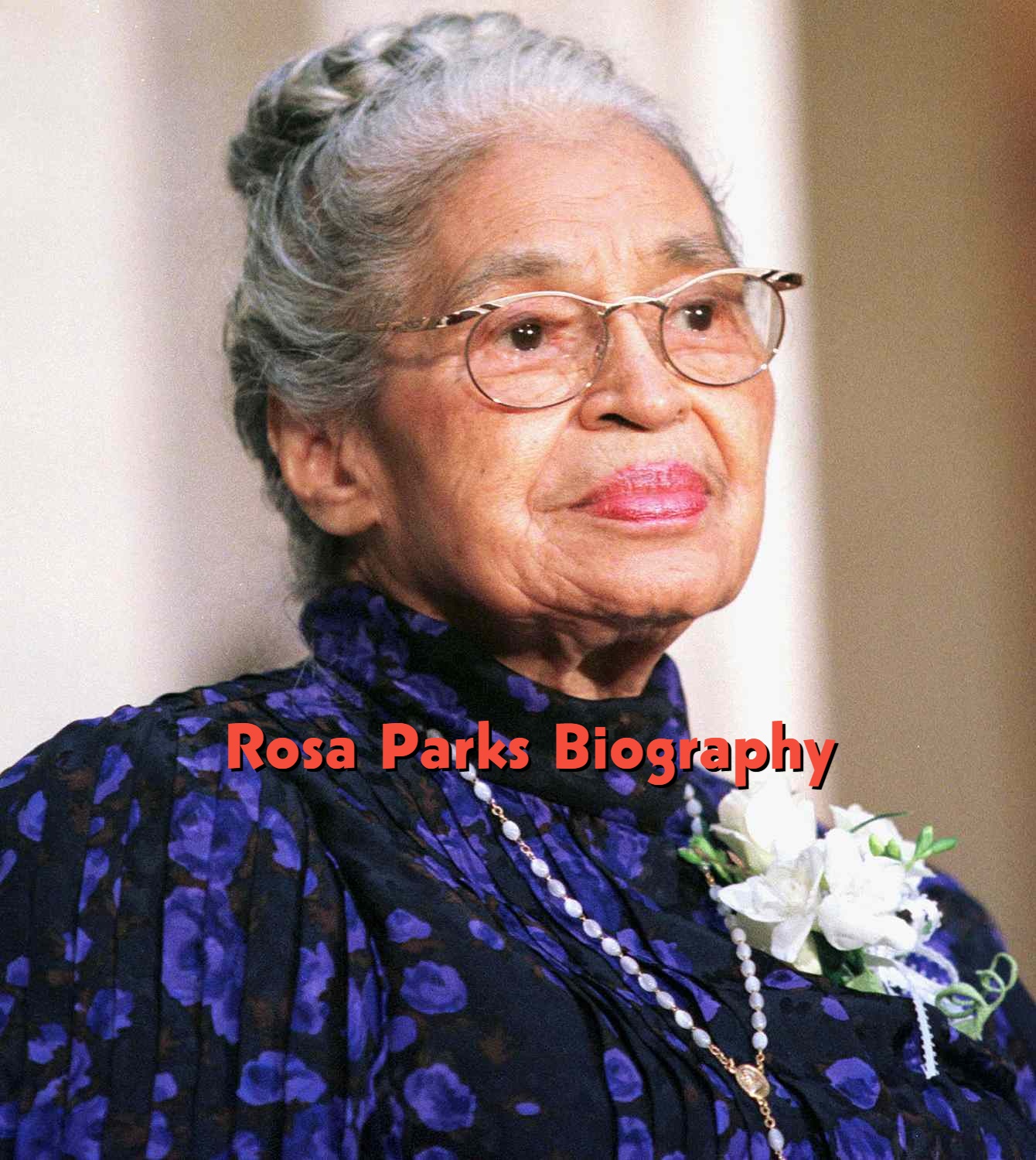
Rosa Parks, born Rosa Louise McCauley, was an American civil rights activist whose quiet act of defiance became one of the defining moments of the struggle against racial segregation. Born on February 4, 1913, in Tuskegee, Alabama, she grew up under the Jim Crow system and later became deeply involved in the fight for racial equality through her work with the NAACP. Her refusal to surrender her seat on a segregated Montgomery bus in December 1955 led to her arrest and helped spark the Montgomery Bus Boycott, placing her at the centre of a movement that would transform American society.
Long before the Montgomery bus incident made her famous, Parks had already spent years challenging racial injustice. As an NAACP activist, she investigated cases of racial violence and discrimination and worked alongside other civil rights organisers in Alabama. Her activism continued long after the boycott, including through her later work in Detroit, where she remained involved in campaigns for racial justice, equality and community development.
See Also: Tarana Burke Biography
Rosa Parks Biography Highlights
- Full Name: Rosa Louise McCauley Parks
- Popular Name: Rosa Parks
- Date of Birth: February 4, 1913
- Place of Birth: Tuskegee, Alabama, United States
- Date of Death: October 24, 2005
- Place of Death: Detroit, Michigan, United States
- Age at Death: 92
- Nationality: American
- Profession: Civil rights activist, seamstress and community organizer
- Known For: Refusing to surrender her seat on a segregated Montgomery bus
- Husband: Raymond Parks
- Years Married: 1932–1977
- Major Organization: NAACP
- Major Event: Montgomery Bus Boycott
- Major Honors: Presidential Medal of Freedom and Congressional Gold Medal
- Famous For: Becoming an important symbol of the American civil rights movement
Rosa Parks Early Life and Family Background
Rosa Louise McCauley was born on February 4, 1913, in Tuskegee, Alabama, to James McCauley and Leona Edwards McCauley. She was the first child in the family and had a younger brother, Sylvester. Her family later moved to Pine Level, Alabama, where she spent much of her childhood.
Parks grew up during the era of Jim Crow segregation, when racial discrimination was embedded in many aspects of American life. The National Park Service notes that as a child she witnessed the realities of racial violence, including Ku Klux Klan activity and the fear associated with nearby lynchings. These experiences formed part of the environment in which her views about racial injustice developed.
Her mother, Leona, was a teacher, and education was important to the family. Rosa was educated first in Pine Level before attending the Montgomery Industrial School for Girls, a private school founded by Alice White. She later attended Alabama State Teachers College for Negroes, although family responsibilities interrupted her education.
Parks eventually completed her high school education in 1934, after marrying Raymond Parks.
Rosa Parks Education
Rosa Parks’ formal education took place in Alabama during a period when Black students faced significant educational inequality.
She attended the Montgomery Industrial School for Girls, where she received an education that helped shape her intellectual development. She later attended Alabama State Teachers College for Negroes, now known as Alabama State University. However, illness affecting members of her family meant that she had to interrupt her studies and return home to help care for them.
Despite not following a conventional university path, Parks continued educating herself throughout her life. Her later activism demonstrated an extensive understanding of racial discrimination, civil rights and community organization.
Rosa Parks Husband and Marriage
Rosa Parks married Raymond Parks on December 18, 1932. Raymond was a barber and an activist who supported her education and civil rights work.
Raymond Parks was involved in the campaign surrounding the Scottsboro Boys, a notorious 1930s case involving nine Black teenagers who were falsely accused of raping two white women in Alabama. His activism influenced the household and helped create an environment in which Rosa became increasingly involved in civil rights work.
The couple worked together in community and civil rights activities. Raymond supported Rosa’s involvement with the NAACP and her efforts to challenge racial discrimination.
Their marriage lasted until Raymond’s death in 1977.
Rosa Parks NAACP Activism
Rosa Parks joined the Montgomery branch of the NAACP in 1943 and became its secretary. She remained involved with the organization for more than a decade.
Her work with the NAACP was considerably broader than the bus protest for which she later became famous. Parks investigated cases involving racial discrimination, police brutality, sexual violence and murder.
She also worked with NAACP leaders including E. D. Nixon, an influential civil rights organizer who later played an important role in the Montgomery Bus Boycott. Parks became involved in documenting cases that otherwise might have received little public attention.
In 1948, she became the first secretary of the Alabama State Conference of the NAACP, further expanding her involvement in civil rights work.
Rosa Parks Investigation of Recy Taylor
One of the lesser-known parts of Rosa Parks’ activism involved her work on the Recy Taylor case.
In 1944, Taylor, a young Black woman from Alabama, was abducted and sexually assaulted by a group of white men while returning home from church. Parks became involved in investigating the case and worked with the NAACP to bring national attention to the failure of the justice system to hold the alleged perpetrators accountable.
The case became an important part of Parks’ development as a civil rights activist. Her activism therefore began long before her famous arrest in Montgomery.
Rosa Parks Work Before the Bus Boycott
Rosa Parks worked in several occupations, including as a seamstress. She also worked at Maxwell Air Force Base in Montgomery.
Her experience at Maxwell was significant because the federal military installation operated under different racial rules from the segregated city surrounding it. The National Park Service notes that Parks could ride an integrated trolley at Maxwell while facing segregation on the city buses she used outside the base.
This contrast helped reinforce her awareness of the fact that segregation was not inevitable and could be challenged through government policy and organized action.
By 1955, Parks was already an experienced NAACP activist rather than simply an ordinary passenger who unexpectedly decided to resist a bus driver.
Rosa Parks Arrest on December 1, 1955
On December 1, 1955, Rosa Parks boarded a Montgomery city bus after work.
At the time, Montgomery buses operated under segregation rules. Black passengers were required to sit in designated sections, and bus drivers could order Black passengers to surrender seats when white passengers needed additional space.
When the bus became crowded, the driver ordered Parks and other Black passengers in her row to move. Parks refused to surrender her seat.
She was subsequently arrested by Montgomery police.
Parks later rejected the popular explanation that she refused simply because she was physically tired. She explained that she was not physically exhausted and that she was tired of continually giving in to racial discrimination.
Her arrest quickly became a catalyst for organized resistance.
Rosa Parks Montgomery Bus Boycott
Following Parks’ arrest, Black community leaders in Montgomery organized a boycott of the city’s buses.
The boycott began on December 5, 1955, the day of Parks’ trial. Black residents were encouraged to avoid the buses and instead walk, use taxis or participate in carpools.
The protest continued for 381 days. Thousands of Black residents participated, and the campaign placed enormous economic pressure on the Montgomery bus system.
The Montgomery Improvement Association was established to coordinate the campaign, with Martin Luther King Jr. becoming its prominent spokesperson.
The boycott eventually contributed to the end of segregation on Montgomery’s buses. A federal court ruling in Browder v. Gayle declared Alabama’s bus segregation laws unconstitutional, and the Supreme Court allowed the decision to stand. Montgomery buses were integrated in December 1956.
Rosa Parks Role in the Civil Rights Movement
Although Rosa Parks became the public symbol of the Montgomery Bus Boycott, she was part of a much larger movement.
The boycott involved thousands of ordinary Black residents, church leaders, organizers, drivers, volunteers and activists. Parks’ arrest provided a powerful catalyst, but the success of the campaign depended on sustained community organization.
Her role also challenged the later simplified image of her as merely a tired seamstress who spontaneously refused to move. She had already spent years working with the NAACP and confronting racial injustice.
In this sense, the Montgomery incident represented a continuation of her activism rather than its beginning.
Rosa Parks Life After the Montgomery Bus Boycott
Parks’ involvement in the boycott came at a considerable personal cost.
She lost her job, while Raymond Parks also experienced employment difficulties because of the controversy surrounding the family. The Parks family additionally received threats.
In 1957, Rosa and Raymond Parks left Montgomery and eventually settled in Detroit, Michigan.
Her move to Detroit did not end her activism. Instead, she continued working on civil rights and social issues, demonstrating that racial inequality was not limited to the American South.
Rosa Parks Activism in Detroit
In Detroit, Parks became involved in campaigns concerning housing, employment, education and racial equality.
She supported John Conyers, who was elected to Congress in 1964. In 1965, Conyers hired Parks to work in his congressional office. She remained in the position until her retirement in 1988.
Her congressional work included assisting constituents and dealing with issues such as employment discrimination, housing and other social problems.
Parks also remained involved in the wider civil rights movement and continued speaking publicly about racial justice.
Rosa Parks Views on Black Power and Racial Justice
Rosa Parks’ activism did not end with the success of the Montgomery Bus Boycott.
During the 1960s, she became supportive of aspects of the emerging Black Power movement, whose activists often advocated approaches that differed from the nonviolent strategies associated with Martin Luther King Jr.
Her later activism reflected a broader understanding of racial inequality, including problems involving housing, economic opportunity and institutional discrimination.
Her experiences in Detroit also demonstrated to her that racial segregation and inequality existed outside the traditional Jim Crow South. The National Park Service notes that she encountered segregation in Detroit schools and housing as well.
Rosa Parks Institute for Self Development
In 1987, Rosa Parks and Raymond Parks established the Rosa and Raymond Parks Institute for Self Development.
The organization was created to provide educational and development opportunities for young people, including programs focused on leadership, employment skills and civic engagement.
The institute represented an important part of Parks’ later life because it allowed her activism to focus on developing younger generations rather than only commemorating the events of 1955.
Rosa Parks Awards and Honors
Rosa Parks received numerous honors during her lifetime.
Among the most significant were the NAACP Spingarn Medal, which she received in 1979, and the Presidential Medal of Freedom, awarded to her by President Bill Clinton in 1996.
In 1999, Parks received the Congressional Gold Medal, one of the highest civilian honors awarded by the United States Congress.
Her recognition eventually extended far beyond the United States, and she became an international symbol of resistance to racial discrimination.
Rosa Parks Death
Rosa Parks died on October 24, 2005, in Detroit, Michigan. She was 92 years old.
Following her death, the United States continued to recognize her historic importance. She became the first woman to lie in honor in the U.S. Capitol Rotunda, an exceptional distinction reflecting her place in American history.
Her death prompted renewed national attention to her life and to the wider civil rights movement in which she had participated for decades.
Rosa Parks Legacy
Rosa Parks’ legacy extends far beyond the Montgomery bus incident.
Her refusal to surrender her seat became one of the most recognizable acts of civil disobedience in American history. More importantly, her life demonstrated that successful social movements are often built through years of organizing before a single event captures national attention.
Parks had already been working with the NAACP for years before December 1955. Her activism involved investigating racial violence, supporting victims of discrimination, organizing young people and challenging segregation.
Her story also illustrates the personal sacrifices that activists can face. The boycott brought her international recognition, but it also contributed to job loss, financial difficulties and threats against her family.
In later years, Parks became a symbol of courage, dignity and resistance to racial injustice. The NAACP marked the 70th anniversary of her historic act in 2025, emphasizing the continuing significance of her contribution to the civil rights movement.
Rosa Parks Net Worth
Rosa Parks’ exact net worth at the time of her death is not reliably established through authoritative public financial records.
Unlike modern celebrities and business personalities, Parks did not build her public identity around personal wealth. Her principal historical significance came from her civil rights activism, community work and public service.
For that reason, online figures claiming a specific Rosa Parks net worth should be treated cautiously unless supported by reliable financial documentation.
Rosa Parks Children
Rosa Parks and her husband, Raymond Parks, did not have biological children.
Much of Parks’ later work focused on young people through education, leadership development and the Rosa and Raymond Parks Institute for Self Development.
Her influence on younger generations therefore became an important part of her legacy even though she did not have children of her own.
Why Rosa Parks Became Famous
Rosa Parks became famous because of her refusal to comply with racial segregation on a Montgomery bus on December 1, 1955.
However, her fame was not created by the bus incident alone. Her arrest became the immediate catalyst for a large-scale community protest that lasted more than a year and ultimately contributed to the desegregation of Montgomery’s public buses.
Her previous NAACP work also meant that she was already an experienced activist when the incident occurred.
Was Rosa Parks the First Person to Refuse a Bus Seat?
Rosa Parks was not the first Black person to challenge segregation on Montgomery buses.
Before her arrest, other Black passengers had resisted discriminatory bus rules. One of the best-known cases involved Claudette Colvin, a 15-year-old who refused to give up her seat in March 1955, nine months before Parks’ arrest.
Parks’ case nevertheless became the central symbol of the Montgomery Bus Boycott. Her established reputation as an NAACP activist and her standing within the local civil rights community made her particularly significant to the campaign.
Rosa Parks Famous Quote
One of Rosa Parks’ most frequently remembered statements concerned the idea that she was simply too tired to move.
She explained that she was not physically tired but was tired of continually submitting to racial discrimination. Her explanation became an important part of how she understood her own act of resistance.
The statement is significant because it emphasizes that her decision was conscious and political rather than an accidental consequence of physical exhaustion.
Rosa Parks Importance in American History
Rosa Parks remains one of the most important figures in American civil rights history.
Her arrest helped ignite the Montgomery Bus Boycott, which demonstrated the power of organized community resistance against segregation. The campaign also helped bring Martin Luther King Jr. to national prominence and became an important early victory in the modern civil rights movement.
Yet Parks’ importance cannot be reduced to one moment. Her decades of activism, her work with the NAACP, her later activities in Detroit and her commitment to youth development reveal a much longer history of resistance.
She died in 2005, but her name remains closely associated with the struggle for racial equality and civil rights in the United States.
FAQs About Rosa Parks
Who Was Rosa Parks?
Rosa Parks was an American civil rights activist best known for refusing to surrender her seat to a white passenger on a segregated Montgomery bus on December 1, 1955. Her arrest helped trigger the Montgomery Bus Boycott.
What Was Rosa Parks’ Real Name?
Her full name was Rosa Louise McCauley Parks. She was born Rosa Louise McCauley and took the surname Parks after marrying Raymond Parks.
When Was Rosa Parks Born?
Rosa Parks was born on February 4, 1913, in Tuskegee, Alabama, United States.
When Did Rosa Parks Die?
Rosa Parks died on October 24, 2005, in Detroit, Michigan, at the age of 92.
Was Rosa Parks Married?
Yes. Rosa Parks married Raymond Parks on December 18, 1932. They remained married until Raymond’s death in 1977.
Did Rosa Parks Have Children?
No. Rosa Parks and Raymond Parks did not have biological children.
What Was Rosa Parks Known For?
Rosa Parks was best known for refusing to surrender her seat on a segregated Montgomery bus in 1955. Her arrest became a catalyst for the Montgomery Bus Boycott and helped bring national attention to the struggle against racial segregation.
Was Rosa Parks an NAACP Member?
Yes. Rosa Parks joined the Montgomery branch of the NAACP in 1943 and served as its secretary. She was involved in investigating racial discrimination and violence before her famous arrest.
How Long Did the Montgomery Bus Boycott Last?
The Montgomery Bus Boycott lasted 381 days, beginning on December 5, 1955, and continuing until December 1956.
How Old Was Rosa Parks When She Refused to Give Up Her Seat?
Rosa Parks was 42 years old when she refused to surrender her seat on December 1, 1955.
Did Rosa Parks Go to Jail?
Yes. Rosa Parks was arrested after refusing to surrender her seat. She was charged with violating Montgomery’s segregation laws and was subsequently found guilty.
What Happened After Rosa Parks’ Arrest?
Her arrest helped spark the Montgomery Bus Boycott, during which thousands of Black residents stopped using the city’s buses. The boycott lasted 381 days and contributed to the eventual desegregation of Montgomery’s bus system.
What Awards Did Rosa Parks Receive?
Rosa Parks received numerous honors, including the NAACP Spingarn Medal, the Presidential Medal of Freedom and the Congressional Gold Medal.
What Is Rosa Parks’ Legacy?
Rosa Parks is remembered as one of the most important figures of the American civil rights movement. Her resistance to racial segregation helped inspire the Montgomery Bus Boycott and became a lasting symbol of courage, dignity and resistance to racial injustice.